Transference
Can a machine extend an artist’s creative trajectory—and develop one of its own?
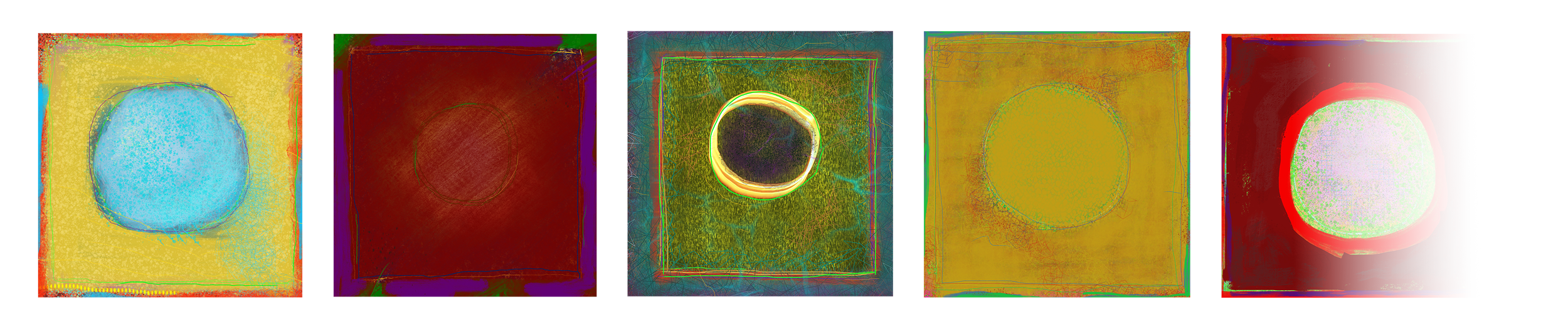
Transference is an experimental art project exploring the boundary between human creative intuition and machine creativity.
The experiment begins with a closed body of work: 20 digital paintings created by the artist, each 15” × 15” and most employing the same deceptively simple vocabulary—a circle within a square. Within that apparent consistency, however, are variations, exceptions, accidents and aesthetic decisions that were made intuitively rather than according to any explicit system.
The artist then withdraws.
An artificial intelligence is given the 20 works and asked to create the next work in the series. It receives no aesthetic direction from the artist. The machine is left to infer what constitutes the underlying logic of the work—and what, if anything, should happen next.
The project asks a deceptively difficult question:
What does a machine believe it has learned from an artist?
Can it distinguish an aesthetic decision from a recurring pattern? Can it recognize an exception as meaningful rather than anomalous? Can it infer the unwritten rules behind an artist’s work? And once it begins making its own decisions, can those decisions influence what it subsequently creates?
The Experiment
Transference explores these questions through three parallel tracks in which only the machine’s relationship to its own previous output changes.
Track One — No Memory
The machine is asked to model the original twenty works twenty separate times. Each time it receives exactly the same source material and exactly the same instruction, with no memory of having performed the task before. Each result is therefore an independent response to an identical problem.
If the results vary, the variation cannot be attributed to learning, accumulated influence or changing source material. It reveals the range of different solutions the machine can produce when nothing about the problem has changed.
Track Two — Memory
The machine is again asked to model the same original twenty works twenty times. The source material never changes. This time, however, the machine retains the results of its previous attempts. When producing the next work, it knows how it has solved the same problem before.
This track asks whether memory alone changes the machine’s response. Does it repeat itself? Avoid repeating itself? Refine an earlier solution? Explore alternatives? Over successive generations, does a recognizable direction emerge even though the original twenty works remain the only works being modeled?
Track Three — Accumulation
The machine begins by modeling the same original twenty works. After it produces a new work, that work is added to the modeling set. The next generation therefore models twenty-one works: the twenty originals plus the machine’s first contribution. That result is added as well, creating a set of twenty-two, then twenty-three, and so on.
Here, the machine is no longer merely remembering its previous work. Its work has become part of the thing being modeled. The experiment asks what happens as machine-generated interpretations progressively enter—and eventually exert increasing influence upon—the original human body of work.
So the distinction becomes very clean:
Track One changes nothing.
Track Two adds memory.
Track Three adds influence.
At what point does the machine cease merely interpreting the artist’s work and begin responding to its own?

The Work
The completed installation will consist of the artist’s original 20 works and 60 machine-generated works—20 from each experimental track—presented together as a single evolving visual system.
The resulting images are important. But they are also evidence.
The work is ultimately concerned with what happens between them: whether creative agency can gradually pass from human to machine, and whether memory, experience and accumulated decisions can transform mechanical prediction into something that begins to resemble an individual creative trajectory.
Transference does not presume to know whether a machine can be creative. It proposes an experiment through which we might watch one try.